
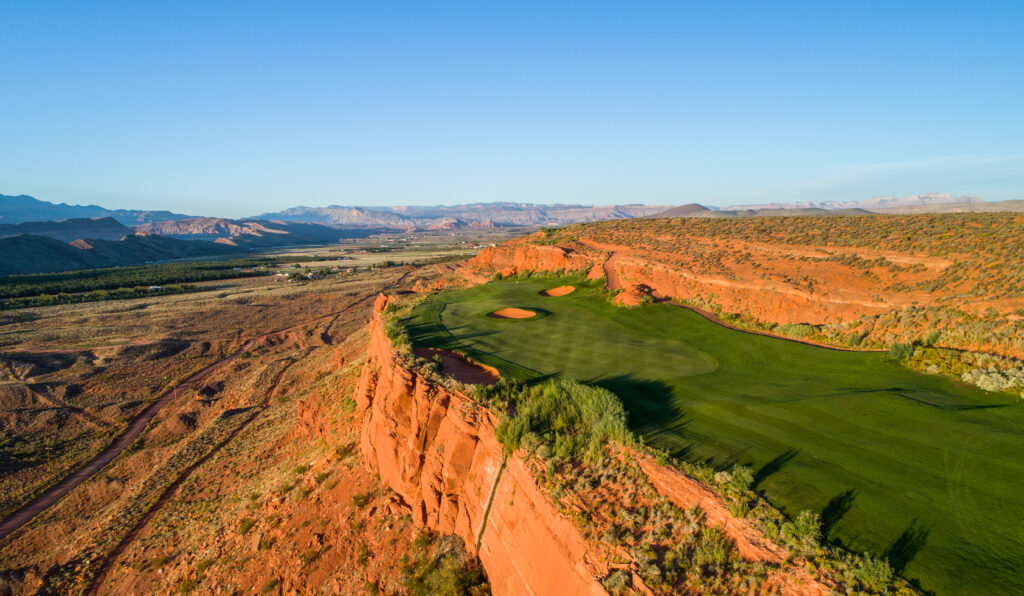
There are plenty of great desert golf courses in the U.S., but Sand Hollow Resort’s Championship Course belongs in a category of its own. Set in Southern Utah’s high desert, this 18-hole layout weaves across red rock cliffs and desert sand with jaw-dropping views at every turn.
From the opening tee shot to the final approach, it’s the kind of course that makes you stop mid-round just to take in the scenery.
But don’t let the views distract you — this track will test every part of your game. The long par 4s will stretch your driver, short par 3s will test your accuracy, and several of the most stunning risk-reward holes you’ve ever experienced will dare you to be bold.
If you’ve got Sand Hollow on your bucket list (and you should), here’s a hole-by-hole guide to help you know what to expect, where to play it safe, and where to take risks.
The downhill opening hole presents stunning views of red rock formations rising behind the green. The wide landing area accepts almost any tee shot, making it a welcoming start. Fairway bunkers sit on both sides, creating more definition than true threat.
Hole 1 – Par 4 (404 – 447 yards)
The green rests on a soft ridge that falls away both in front and behind. Meanwhile, two bunkers guard the left side, making accuracy important on this otherwise generous opener.
How to Play It: This is as friendly an opener as you’ll find, so don’t waste it. Take driver and trust the width — the bunkers look more menacing than they are. On approach, resist chasing pins near the edges. Anything long or short will run off the ridge, so center of the green is almost always the play.
Hole 2 – Par 5 (497 – 577 yards)
This par 5 features a fairway that bends slightly to the right as it meanders along the beautiful red rock formations. From the tee, do your best to avoid a lone bunker that has been built into a small hillock.
On your second shot, two bunkers frame the lay-up area on the left and right. The approach requires a delicate touch to carry a front bunker and land softly on a narrow, elevated green. Subtle movement across the surface makes it a challenge to hold and putt.
How to Play It: Forget about reaching this in two unless you’ve striped your drive and the wind is helping. The safe line is right of the lone bunker off the tee, then thread your lay-up between the fairway bunkers. Into the green, take plenty of club — the front bunker is a well-known ball magnet for weak shots and cautious swings.
Hole 3 – Par 3 (134 – 208 yards)
The tee shot drops slightly down to the green. A cavernous bunker sits on the left side, positioned well short of the target.
The putting surface is among the largest on the course, riding gently along a ridgeline. Its movement is both interesting and diabolical, testing distance control and green reading. When you pick your ball up out of the hole, be sure to take in the spectacular mountain views that create a vivid and memorable backdrop.
How to Play It: Don’t let the big bunker distract you — it’s closer than you think. Pick your yardage, commit, and hit the middle of this oversized green. On the green, be patient: a two-putt par here is a win.
Hole 4 – Par 4 (344 – 463 yards)
This lengthy par 4 bends left around a sandy waste area that includes a large bunker built into the rough. The landing area is banked right to left and shadowed by red rock formations.
Approaching the hole, a fore bunker sits short of the target, making the elevated green appear closer than it truly is.
How to Play It: Play your tee shot to the high side — right of center — to keep from being kicked left. Into the green, take an extra club. That front bunker makes everything look closer than it is, and coming up short here leaves a very tough up-and-down.
Hole 5 – Par 4 (244 – 355 yards)
Here the safe choice is to play to the right center of the fairway, away from the bunkers that border the left side. The riskier route is to drive over those bunkers and carry the native area, which can put the ball on or near the small green.
The putting surface itself is tricky. A shallow swale runs along the left side, while a greenside bunker guards the right.
How to Play It: Classic risk-reward. If you’re swinging well, take driver at the bunkers — clear them and you might just find yourself with a putt for eagle. If not, lay up to the right center, wedge it close, and take your birdie chance that way.
Hole 6 – Par 4 (354 – 493 yards)
Accuracy is a must on this hole, the longest par 4 on the front nine. A tee shot that finds the crest of a raised plateau reveals the green below in full view.
The approach plays into a large target that is protected at the entrance by bunkers on both sides. The green has numerous breaks and hollows, creating difficult lines to negotiate.
How to Play It: This is one of the toughest asks on the front nine. A controlled tee shot that gets you to the plateau is more important than distance. From there, ignore the flag and play for the middle of the green — long putts are easier than short-sided chips here.
Hole 7 – Par 5 (453 – 577 yards)
This par 5 is straightforward in shape, but the difficulty intensifies with each shot. Off the tee, a wide landing area with natural rolls and bumps greets your drive.
On the second shot, two crossing bunkers must be carried, as they also obscure the view of the fairway beyond. The lie for the approach can often be awkward. Two more bunkers cross in front of the green, which itself rolls naturally along the sand dunes.
How to Play It: Play it as a three-shotter unless you’ve got the length to carry the crossing bunkers cleanly. Get your lay-up past them and you’ll have a flat lie. Into the green, keep it straight — those two front bunkers love to catch approaches that leak left or right.
Hole 8 – Par 3 (121 – 162 yards)
The shortest hole on the course is far from simple. The green is positioned at the edge of a ridge, where the ground falls sharply away on the left.
Bunkers, once again, stand guard on both the left and right sides, punishing errant tee shots.
How to Play It: Don’t even glance at a left pin. Center of the green is the smart play — you can still make birdie with a good putt. Anything left is trouble, and the bunkers right aren’t much better.
Hole 9 – Par 4 (317 – 433 yards)
This hole plays much longer than its yardage suggests. The fairway begins fairly level and leads to a generous landing area.
The approach, however, climbs to a green that is elevated roughly 25 feet. A deceptive fore bunker sits nearly 30 yards short of the landing surface, which is angled along the ridgeline near the clubhouse. When you’re not staring at the little white ball, be sure to glance up, as the rock formations in the foreground will leave you breathless.
How to Play It: Don’t let the number fool you — this plays uphill all the way. Take at least one more club than you think on the approach. That front bunker short of the green is a decoy — make sure you carry it and get all the way up. Play this hole longer than it looks, and you might just pick up a stroke to close out the front nine.
Hole 10 – Par 5 (430 – 565 yards)
The fairway bends first to the left and then back to the right as it heads toward the green. The tee shot plays decidedly downhill and must carry a directional bunker.
On the second shot, bunkers mark both sides of the fairway, leaving little margin for error. Closer to the green, the hole widens to nearly 45 yards across. The green itself is long but narrow, and is the smallest on the course.
How to Play It: Stay disciplined. Take on the directional bunker with a confident drive, then lay up to your preferred wedge yardage. If you do smoke a drive, going for this tiny green in two is high-risk, but well worth the reward for those that succeed.
Hole 11 – Par 3 (114 – 190 yards)
A severe penalty awaits any shot missed to the right on this par 3. The left side is more forgiving, thanks to a slope that feeds balls toward the green.
The putting surface is positioned near the edge of a cliff, with bunkers marking the danger nearby. On windy days, the hole can shift from inviting to vicious.
How to Play It: Always favor the left. Use the slope to feed the ball toward the green. Missing right will leave you heartbroken after the loss of that beautiful Pro V1 you hoped would last your whole round.
Hole 12 – Par 4 (294 – 443 yards)
You’ve arrived. Spectacular mountain views frame this hole. The uphill fairway hugs the edge of a sheer red rock cliff that runs along the entire right side.
The approach must carry two ominous fore bunkers placed about 30 yards in front of the green. By contrast to the surroundings, this green looks relatively flat–but don’t let it deceive you. This green is just as slippery as the rest.
How to Play It: Let the big dog eat (you know you want to). Into the green, commit to carrying those front bunkers. Being long is far better than coming up short.
Hole 13 – Par 4 (200 – 320 yards)
This short par 4 is set on a natural plateau with dramatic views of the red cliffs and distant, mountains. Steep rock outcroppings pinch the right side of the fairway, while a strategically placed bunker marks the left.
The green is long and narrow, bordered by a steep grassy edge on the left.
How to Play It: Accuracy matters more than power. Keep your tee shot between the pinch points and avoid the bunker left. Into the narrow green, favor the middle and don’t challenge the edges.
Hole 14 – Par 4 (333 – 525 yards)
From the back tees, this is one of the longest par 4s you’ll ever play. The drive runs uphill and over a rock outcropping to a blind landing area.
From there, the approach plays nearly 45 feet downhill into a large green that is guarded on the right by a massive bunker. The tee shot becomes less intimidating from the forward tees, but the approach still requires the same accuracy.
How to Play It: Don’t overswing on the blind tee shot — just clear the hill. Into the green, trust your downhill yardage and never miss right. Par here is a terrific score.
Hole 15 – Par 3 (113 – 230 yards)
This par 3 is visually spectacular. The tee offers a perfect view of the green, which rests among rugged rock outcroppings roughly 35 feet below.
Three carefully positioned bunkers add both beauty and strategic challenge.
How to Play It: Enjoy the view, but focus on your number. Club selection is everything on this downhill shot. Middle of the green is always a smart choice. Don’t be short or left–for obvious reasons.
Hole 16 – Par 4 (266 – 369 yards)
A modest hole in length, this par 4 features a fairway that gently follows the land’s natural contour. A huge bunker stretches from the landing area all the way to the front of the green.
The putting surface sits within a natural swale, demanding a precise approach.
How to Play It: Take less than driver off the tee to stay short of the big bunker. From there, wedge in with control. This hole rewards precision, not power.
Hole 17 – Par 5 (415 – 523 yards)
This hole is considered a classic “swing hole” that can either make or break a round. The fairway is best approached from the left center.
The second shot must carry a massive native sand pit that cuts across the fairway. The green is elevated and protected by menacing bunkers.
How to Play It: Keep your drive on the left-center line for the cleanest angle. If you can’t comfortably clear the sand pit, lay up and trust your wedge game. The elevated green plays tough, so try to leave yourself an uphill putt.
Hole 18 – Par 4 (357 – 435 yards)
The finishing hole begins with two carefully placed bunkers that make the left side the preferred angle for the approach.
The green is elevated into a rugged red-rock ridge, requiring a full carry to get home on the second shot.
How to Play It: Hug the left side off the tee for the best line. Into the green, take enough club and commit — this final approach is all carry, so swing confidently.
Book Your Tee Time At Sand Hollow
Towering red cliffs, endless desert skies, and panoramic views at every turn make the Championship Course at Sand Hollow Resort one of the most unforgettable experiences in golf.
But from one golfer to another, you didn’t come just for the views. Play smart, lean on the tips in this guide, and you’ll leave Sand Hollow with memories that last — and a scorecard you might just want to frame.
Ready to play it for yourself? Book a tee time at Sand Hollow Resort and experience why this course belongs on every golfer’s bucket list.